Fair Notes: Milan
A gamble that paid off.

As someone who works mainly with American clients but lives in Europe, I’m still figuring out which non-US fairs belong on my annual circuit. Each year I test new territory — seeing whether the work, events, galleries and institutions of a city resonate with me and my clientele. Last year, Marseille. This year, Milan.
The expansion of Paris Internationale to Milan was a major pull but the main fair miart has long been considered by some as not very good… mainly for its lack of contemporary presence, so making the trip was a gamble. Although, is a week in Milan ever really a gamble? Anyway, pleased to report: the fairs were full of ambitious works — photography and sculpture bursting with tension and beauty, art by women everywhere and a new-to-me Italian artist I’m desperate to share beyond the boot.
miart was spread across a few floors, a floor per section (Emergent, Established and Established Anthology). This multi-floored layout allowed for breathing room. The Established Anthology section (blue-chip) was housed on the top floor, an area you had to actively seek out, with no signs ushering you up — rewarding the curious and the need-to-know. The space itself was a reflection of the fair’s mood: unhurried, fewer presentations, fewer people. No jostling, just looking and taking it all in.
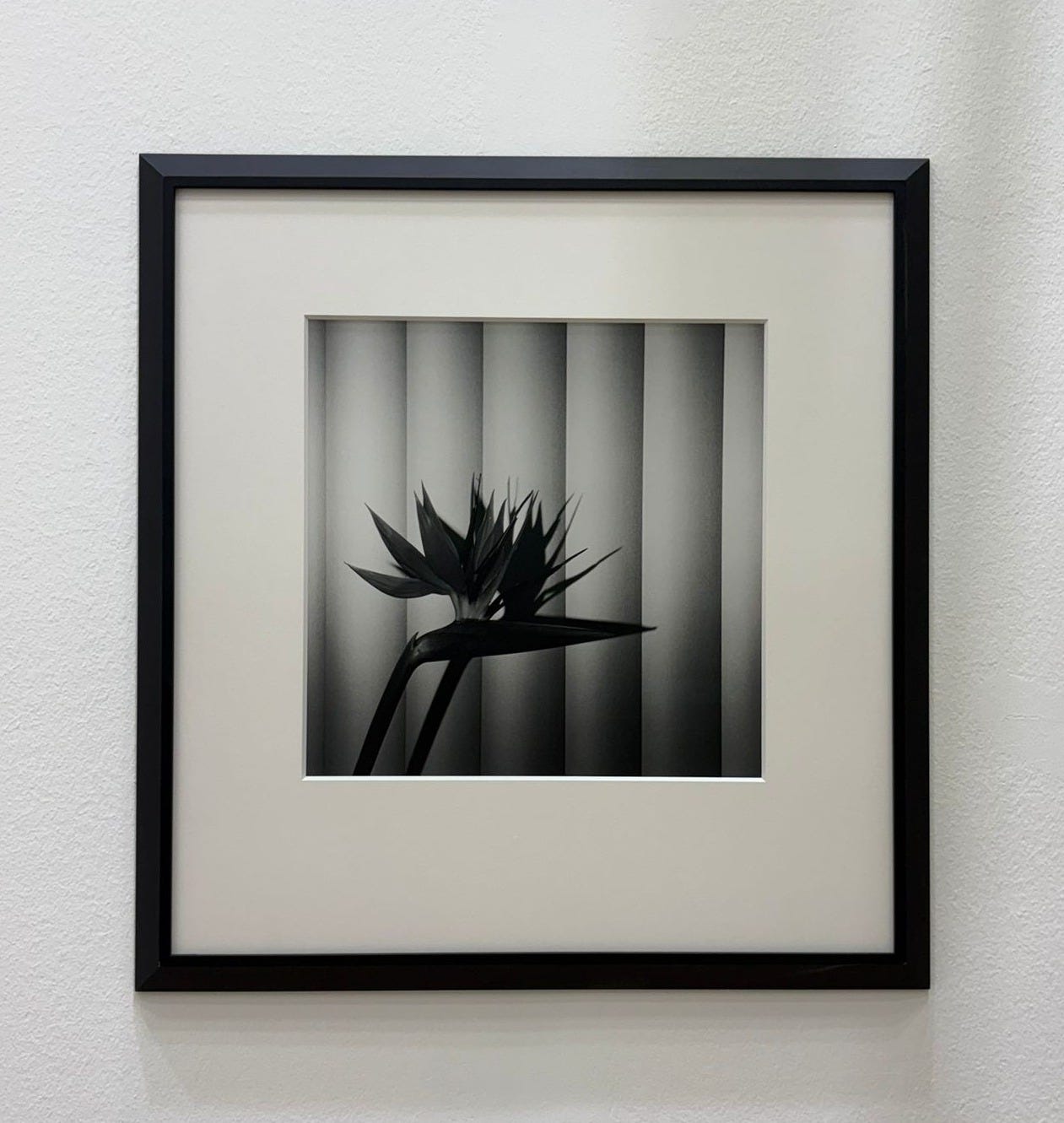
Across the city, one thing was clear: Mapplethorpe has conquered Milan. His work appeared at both fairs, alongside a retrospective at the Palazzo Reale. At miart, his 1980s studio photography was shown in dialogue with new work by Italian artist Jacopo Benassi. Mapplethorpe gives flowers and nude bodies the formal rigor of sculpture, Benassi’s mixed-media assemblages are bound with barbed wire and plywood. Both refuse any perceived fragility or flatness.


Outside of the Benassi x Mapplethorpe overload, there were photos by Ming Smith and Fabrizio Garghetti (amongst others scattered throughout the fair), following the lead of institutions globally where photography is on the rise. In London, 2025 closed with Lee Miller and Peter Hujar, with 2026 starting with Wolfgang Tillmans, Nan Goldin, Gordon Parks and a forthcoming retrospective of Ana Mendieta. There’s a major survey of African photographic portraiture on at MoMA in New York, Nan (again) in Paris — at the Grand Palais, no less. Sophie Calle at the Louisiana! Baldessari in Beijing! The list goes on. If you’re considering expanding your collection to include photography, take this year to immerse yourself in the medium and get in touch for personalized selections.
While the Emergent section was a bit underwhelming (it seems the best was saved for Paris Internationale), there was one booth right at the entrance that made it all worthwhile.
A solo presentation by Japanese artist Emi Mizukami, whose work I’d been following online but needed to see in person before committing. And yes, they give so! much! more! in person. Which is truly what you want from an artwork. Never the other way around.


Her works seem delicate and they are — drawings and paintings layered over a paste made from desert sand. The same care given to the front is also given to the back of the canvas: little love letters in the form of drawings, from painter to patron. I wasn’t the only one who took notice — most of the booth was sold out by midday of the VIP preview. With works starting at $2,500, they’re a great entry point for any collection.


In the Established section (above) there was more to fawn over, and yet more still in the Established Anthology section (below) — the top floor or the Upper Room as I like to call it.


Paris Internationale
Across the city was PI, a fair for the emerging and daring — punchy presentations from galleries across Europe, Asia and the US. Though at the Milan edition no US galleries were present, which may be down to the oversaturation of US fairs this past week across Chicago and Dallas, with the New York mayhem still to come.
There was a refreshing presence of female artists, both living and deceased. A few major highlights for me: paintings by Inès di Folco Jemni, a joint booth with Lizzi Bougatsos & Andrea Salvino’s romanticized, grungy reflections on the XXth Century, intimate collages by the late Anna Zemánková, and sculptures by Dominique White and Nicole Wermers.

First up: the French Tunisian painter, Inès di Folco Jemni, a forever favorite.
Le Poison is a vivid mythological landscape of a sea-like vista with a slithering silver serpent beneath an omnipresent wash of bright green across the sky, reminiscent of Richard Mayhew’s dreamlike hues. Alongside these larger landscape paintings, she also created smaller portraits on wooden panels as an ode to the history of small-scale portraiture in Milan. I included a work on paper by her in my January Catalogue — another perfect starter piece for any collection.


Next, Dominique White (who is currently exhibiting at the Kunsthalle Basel!) with a monumental and haunting sculpture which evokes the shipwrecked debris of Black diasporic maritime mythologies. The white debris spread across the fair floor gave the installation a site-specific quality, the pointed precarious edges of the anchors and rusted patina giving it a nostalgic antiquity, perfect for the Italian audience, where history isn’t archived but lived in. Tension everywhere.
Leading me to these delicate yet powerful textile-collaged drawings by the late self-taught Austro-Hungarian artist Anna Zemánková, whose talent was discovered late in life. I was first introduced to her work at a gallery in London early last year which placed her work from the 60s-70s in a contemporary context. They brought me back to a series of plant studies painted on saree fabric by Ishita Chakraborty I'd seen earlier at miart.


These dramatic Nicole Wermers sculptures of women mid-faint — draped, collapsed, overcome — are sold with a curated selection of luxury crisps (chips). Yes, you read that correctly. The bags are perishable by nature, so the selection is generous enough to last. The sculpture endures. The crisps do not. Perhaps drawing us back to true custodianship? A work that demands maintenance and regular attention.


Overall, Paris Internationale was an exciting fair, a strong start for its Milan iteration.
Galleries
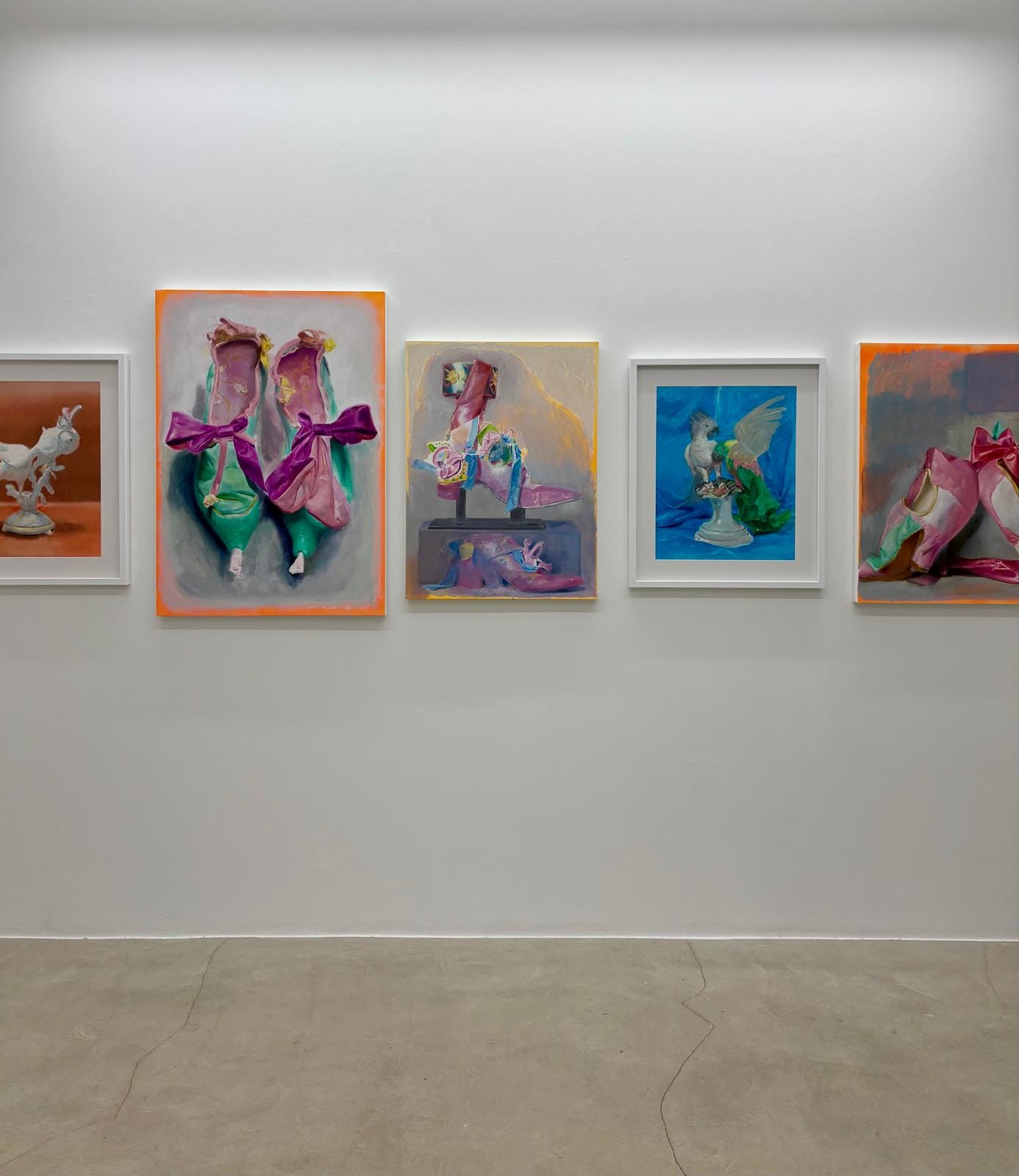
Art fair travel is of course to witness the familiar but also (hopefully) to discover new and local talent. Milan delivered just that, discovery unbound. I fell hard for Pierpaolo Campanini’s elegantly punk paintings at a gallery opening in the city. While fairly established in his career, with representation by not one but two (!) prominent galleries in Italy/New York and London. Somehow, the artist has limited visibility outside of Italy so here I am doing God’s work and bringing his greatness to you!
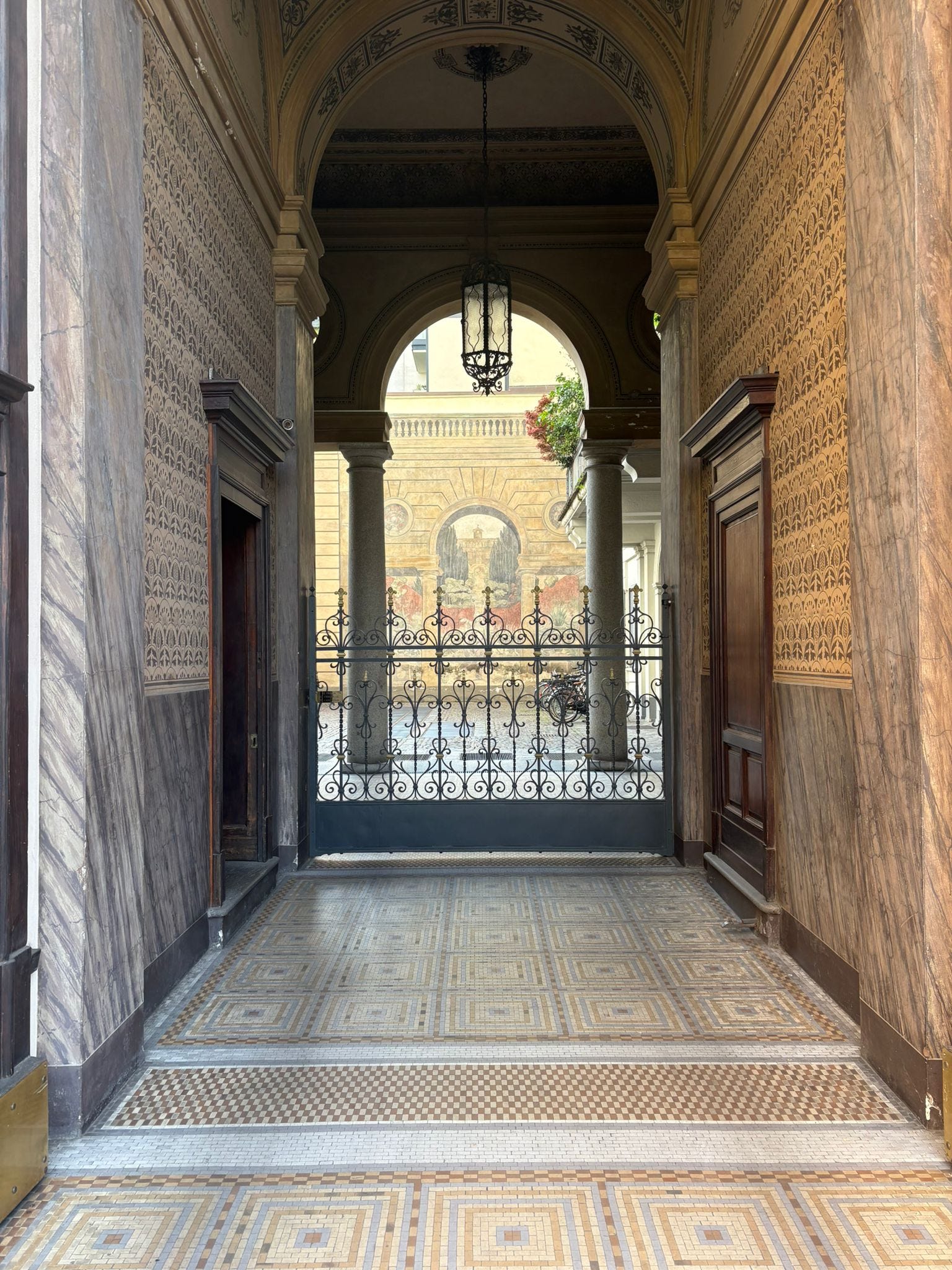
The theme of my week in Milan: take time. Take a walk, enjoy the sunshine, sprinkle in some art. And be overloaded by sharp Milanese building design while holding yourself back from wandering sneakily into every perfectly tiled courtyard entrance.
Which made Nancy Lupo’s Paraselene at Spazio Veda — the show that closed out my week — hit even harder. Wow.
A lot to cover but thanks for reading to the end! Back in a few weeks with New York fair coverage 😎
In the meantime: I travel regularly to fairs and institutions around the world to research and source artists for my clients’ collections. If you’re ready to build something that resonates with who you are and where you’re going — culturally and financially — get in touch.